Research guide
Tirzepatide study terms: how to read a decision to stop
A plain-language guide to denominators, overlapping outcomes and missing observations in a study table.
Published · 12 minute read
A statement that someone stopped sounds complete until you ask what ended. Taking a medication, attending a research visit and allowing further information to be collected are different activities. A useful reading of tirzepatide research therefore starts with the verb and its object, before deciding what a percentage means. This guide treats the accompanying figure as a reading exercise: identify the recorded outcome, connect it to the eligible group, and then decide which question that combination can answer.
Our interpretation concentrates on the structure of the evidence. A table is a compressed description, not a collection of complete personal stories. Its labels help recover the question being summarized, while its omissions show where a different record would be needed. Reading it carefully means resisting an attractive shortcut: treating a stopping percentage as a general score for comfort, success or suitability. Those ideas require their own definitions and observations. The reasoning below explains how to keep them separate without dismissing the information the table does contain.
Wide tables can scroll horizontally. Keyboard users can focus a table region and use the arrow keys to move across it.
Reading the evidence
- Complete the sentence
- Ask what stopped, for which recorded reason, and among whom before interpreting a percentage.
Sources: Rubino et al.
- Keep the comparison explicit
- A contrast between outcome definitions answers a different question from a contrast between assigned treatments.
Sources: Rubino et al.
- Separate totals from histories
- Category totals alone do not identify which individual records overlap.
Sources: Rubino et al.
- Give missingness a name
- An unavailable later measurement is not interchangeable with a measured absence of an event.
Sources: Rubino et al.
- Preserve the question
- A result becomes easier to interpret when its unit, denominator and observation rule travel together.
Sources: Rubino et al.
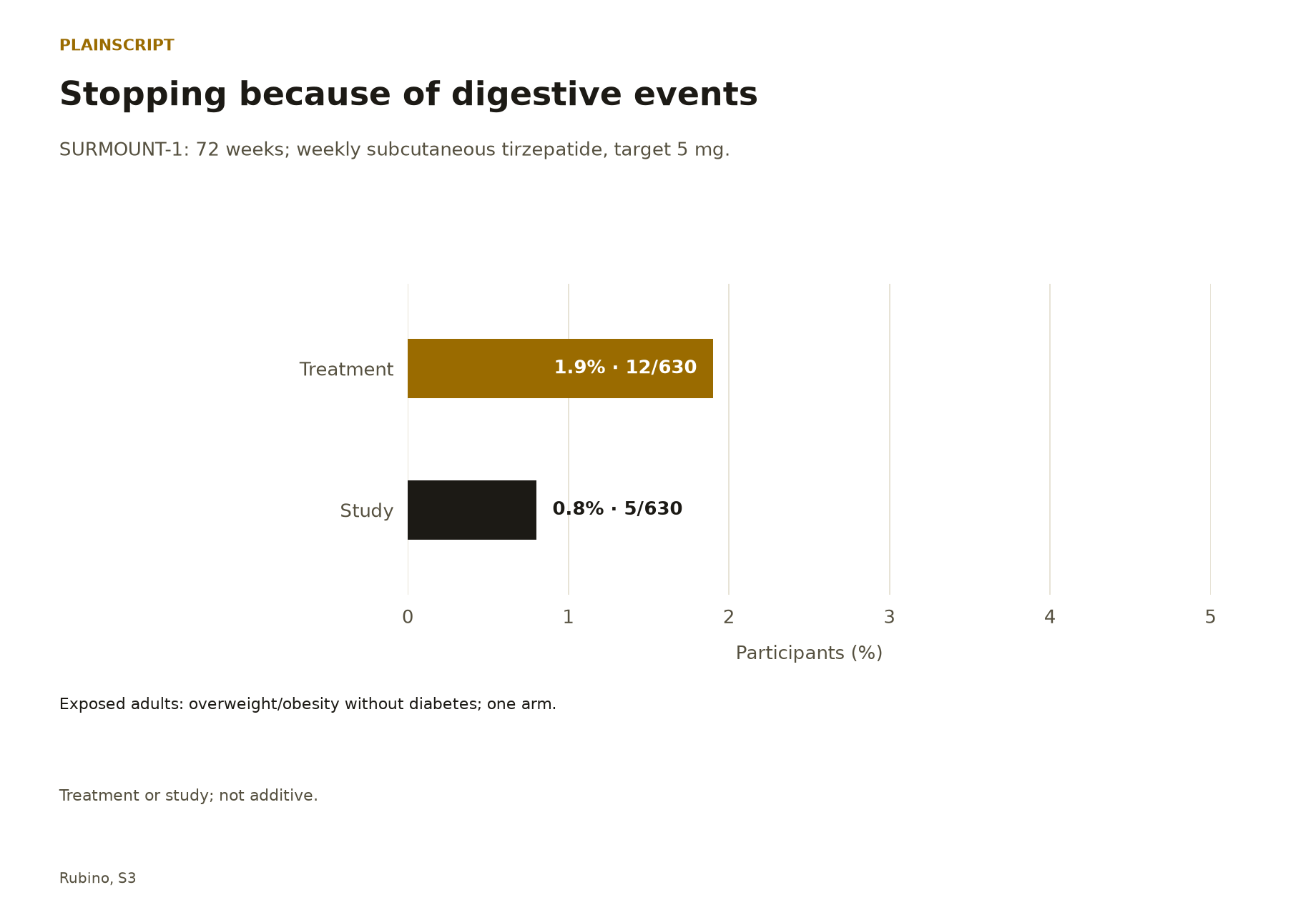
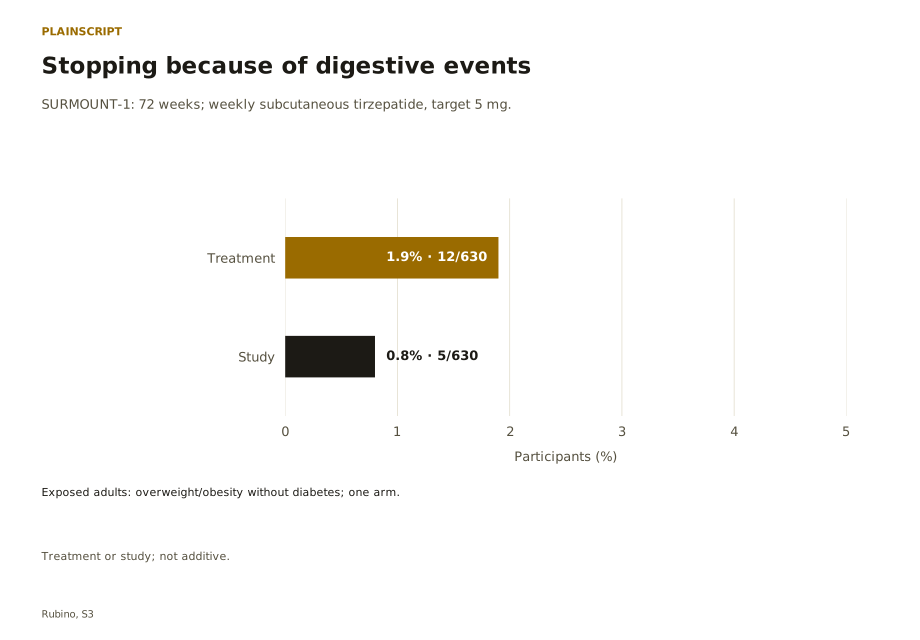
Stopping because of digestive events
SURMOUNT-1: 72 weeks; weekly subcutaneous tirzepatide, target 5 mg.
Exposed adults: overweight/obesity without diabetes; one arm.
Treatment or study; not additive.
Sources: Rubino et al.
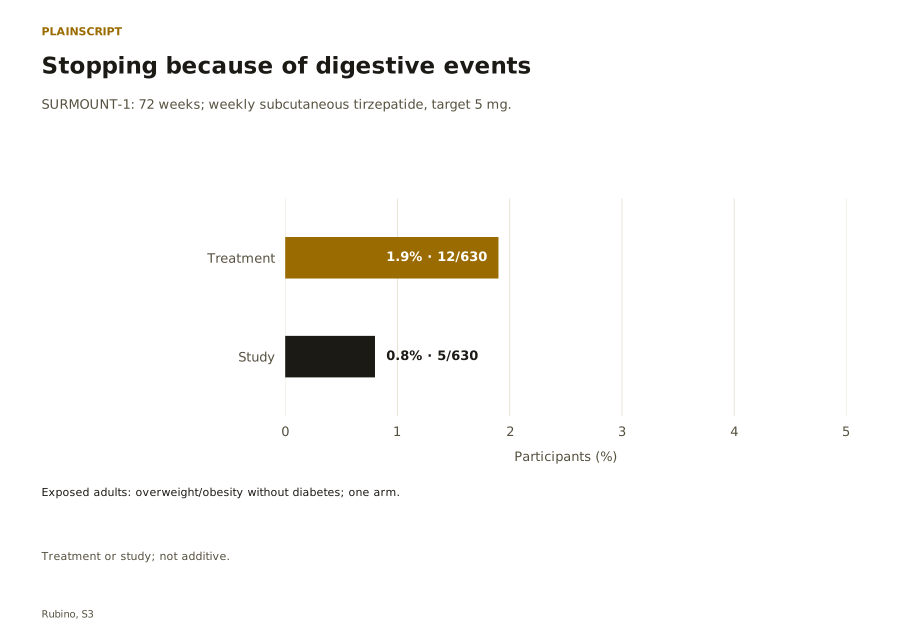
| Outcome | n/N | Percent |
|---|---|---|
| Treatment | 12/630 | 1.9% |
| Study | 5/630 | 0.8% |
A stopping statement needs a complete question
Start by writing the outcome as a sentence with an object. Then add a reason and a population. This is an editorial reading method: it makes an abbreviated table heading behave like a precise question. If a sentence remains ambiguous after those additions, the percentage cannot resolve the ambiguity. A numerical answer is only as clear as the event definition attached to it. The same everyday word can describe different changes in a research record, so familiar wording deserves careful attention.
Rubino’s post hoc analyses excluded data after treatment stopped. Lilly funded the work; six authors were employees and shareholders.
That factual context belongs beside the analysis, but the methodological work still has to be done. A funding statement helps identify relationships readers may want to examine; it does not, by itself, decide whether an endpoint was counted appropriately. Likewise, identifying an analysis as post hoc raises questions about how the question was selected and how much confidence a further investigation would add. Neither label substitutes for checking the outcome definition. Keep separate notes for who produced the evidence, what was counted, and which inference you are considering. Each note supports a different part of a careful appraisal.
Sources: Rubino et al.
Keep the denominator attached to the outcome
A numerator is the count of records meeting a stated condition. The denominator identifies the set against which that count is expressed. Read them as a pair. Replacing the denominator with a larger, more prominent enrollment total would change the question, even if the replacement came from the same research program. The right choice follows the population eligible for this particular summary. It should not be chosen because it is easier to remember or because a larger number appears to make the evidence more impressive.
For the displayed comparison, ask whether the group is being held fixed while the outcome changes. If so, the visual contrast concerns definitions applied to that group. It is not automatically evidence about how different assigned treatments compare. Equal denominators would also not establish that the same people qualified for each outcome: a shared reference set and overlapping numerator membership are separate properties. This habit of pairing a term with its reference context also helps when reading a label and its paperwork, although a clinical label and a study table serve different purposes.
| Reading question | Record needed | Premature conclusion |
|---|---|---|
| Who could enter the numerator? | The outcome eligibility definition | Everyone named elsewhere in the study was eligible |
| Which group supplies the denominator? | The analysis population for that table | The most prominent enrollment total is interchangeable |
| What changes across the comparison? | The group and outcome labels together | Adjacent bars necessarily compare treatments |
Sources: Rubino et al.
Separate the treatment record from the visit record
Consider the kinds of records a research system could maintain. An intervention record can describe whether treatment was taken. A visit record can describe whether an observation was collected. A participation record can describe a person’s status in the study. These are logical distinctions, not claims about the path followed by a particular participant. Linking them would require compatible identifiers and dates. Without that linkage, a reader should not replace a missing history with the most familiar everyday meaning of leaving.
The distinction matters because an event and the opportunity to observe later events are different parts of a research question. It is possible in a study design for an intervention to end while information collection remains possible. It is also possible for an intended observation never to become an available measurement. These possibilities explain why the relevant records would need examination; they do not tell us which possibility occurred for anyone represented in the figure.
A precise reading therefore keeps the activity, the decision and the subsequent information separate. The same discipline is useful when interpreting prescription wording: a document’s purpose determines what its entries establish. Here the objective is narrower—understanding a research outcome. It does not authorize a reader to convert a recorded study decision into a personal treatment instruction.
Sources: Rubino et al.
Category totals do not reconstruct individual histories
An outcome table can tell you how large a category is without identifying its members. That is a limit of the information format, not an accusation that the records are defective. To establish overlap, the reader would need to know which individuals satisfy each definition. A joint classification would show that relationship; separate totals do not. The appropriate response is to leave the membership relationship unresolved rather than fill it in with an intuitive story.
Subtraction is especially tempting when the labels sound nested. But a difference between totals becomes a count of a meaningful subgroup only after the required set relationship has been established. The arithmetic cannot prove that relationship. Addition has a parallel problem: it can count the same person again if categories overlap. Before using either operation, state the logical assumptions in words. If those assumptions cannot be checked from the available evidence, the calculation is not a reconstruction of participant histories.
This approach also clarifies why visual simplicity should not dictate the conclusion. A compact chart can be easy to read while representing categories whose relationship needs explanation. Our semaglutide guide to study terminology develops another question about classification. Read the guides as complementary methods exercises, not as a combined comparison of medications. Similar-looking displays do not make different outcomes interchangeable.
Sources: Rubino et al.
Read the recorded reason before taking a complement
A cause-specific outcome counts an event under a particular reason definition. Its complement means only that the person did not qualify for that specified combination in the summary. It does not automatically establish the opposite of every word a reader associates with the event. For example, failing to meet a stopping definition is not logically equivalent to having a comfortable experience. Comfort would need its own measurement, and a treatment benefit would need another. The absence of a qualifying record is a narrower statement than either conclusion.
This is a useful place to distinguish a measured zero from missing information. A measured zero requires an observation process capable of registering the event and an interpretable result from that process. Missing information instead leaves the intended observation unavailable. Treating the latter as the former can make a summary appear more complete than its records justify. The appropriate question is not whether the remaining category sounds reassuring, but what positive evidence supports its proposed meaning. Keeping the endpoint specific allows a stopping measure to remain useful without asking it to represent every aspect of an experience.
Sources: Rubino et al.
A stopping event and later measurements occupy different places
The observation boundary described earlier deserves a logical reading. A rule governing which later measurements enter an analysis does not, by itself, erase the event that defines that boundary. Event recording and subsequent outcome inclusion are separate operations. Confusing them can produce a mistaken argument that a stopping outcome could not have been recorded at all. The relevant question is which record supports which summary, and at what point the rules for including information change.
Thinking in sequence helps: define the eligible information, identify the event of interest, and ask what later observations would be required for the next question. This is an analytic sequence, not a reconstruction of anyone’s clinical course. It exposes where a question about continued benefit or symptom resolution would need information beyond a stopping count. A table may support the event summary while leaving those later questions unresolved.
Missing later observations do not tell a reader which direction an estimate would move if the information became available. The answer depends on the missing values and the reason for their absence, neither of which can be supplied by optimism or pessimism. For broader reading, see the existing guide about questions raised by stopping a GLP-1. The link provides another reading topic; its presence does not supply missing observations for this analysis.
Sources: Rubino et al.
A whole-window proportion has no built-in calendar
A proportion collected over an observation window compresses time. From the resulting total alone, a reader cannot recover when the qualifying events occurred or how evenly they were distributed. A monthly interpretation would require more than dividing by the duration named in a caption. It would require a defensible model of time and an account of who remained observable and eligible as time passed. The numerical convenience of division does not create those assumptions or make them appropriate.
Duration is another distinct question. Knowing whether an outcome occurred does not show how long a preceding symptom lasted, how often it returned, or how much time separated a symptom from a recorded decision. A timeline would need linked dates and explicit rules for beginning and ending intervals. Those requirements explain why a count is informative yet insufficient for a history. They also show what a more detailed analysis would need to report. Readers can preserve the value of the count while declining to turn it into an unsupported calendar, average waiting period or prediction of an individual sequence.
Sources: Rubino et al.
Treatment benefit requires a different causal question
A stopping endpoint concerns a recorded decision under a definition. An efficacy endpoint concerns a treatment outcome. To ask whether symptoms help produce a benefit introduces a further question about causation. None of these questions becomes equivalent merely because the same medication appears in the discussion. A causal explanation needs a comparison that addresses alternative explanations, a defensible ordering of events, and clarity about which influences are being held fixed. A stopping count alone cannot supply that structure.
A group defined by something that happens after treatment begins is not automatically comparable to another such group. The defining event may be connected to other differences that also matter for the outcome. Random assignment of treatment, where established, would answer a question about assigned treatment; it would not automatically randomize every later experience. This distinction helps explain why a descriptive association deserves a different reading from a causal test. Product identity also needs its own care: the guide to what compounded means is related terminology reading, not evidence that a research result transfers to a preparation or a provider.
Sources: Rubino et al.
Turn a table into answerable evidence questions
A productive question identifies the observation that would resolve it. Asking whether everyone who stopped treatment remained in follow-up requires linked participation records, not a more forceful interpretation of category totals. Asking whether a stopping decision followed a particular symptom requires a timeline and an attribution rule. Asking whether unobserved outcomes would change a conclusion requires an explicit treatment of missing information. These questions lead to different records, so they should remain separate in a reading notebook.
The methods table below is our interpretation tool. It specifies the next kind of evidence to seek without suggesting that it has already been collected or examined here. Its value lies in making uncertainty operational: instead of writing only that more research is needed, identify which missing relationship prevents the desired inference. That makes a limitation something the reader can understand and a future analysis can address.
Administrative questions belong in a separate document check. Our BetterMe Rx review and altRx review can be starting points for locating questions about written terms. Those links do not connect either provider to a study outcome. A contract record and a clinical research record establish different things, even when an everyday word such as stopping appears in both.
| Question | Evidence to examine | Why the count is insufficient |
|---|---|---|
| Do the outcome groups overlap? | Linked participant classifications | Separate totals do not identify shared membership |
| When did the decision occur? | Dated event and observation records | A whole-window summary removes ordering |
| What happened afterward? | Defined follow-up measurements and missingness rules | An event count does not contain later outcomes |
| Does an association explain benefit? | A design and analysis addressing causal alternatives | Descriptive membership does not establish a mechanism |
Sources: Rubino et al.
Carry clear definitions into a clinical conversation
Zepbound’s label contraindicates use with personal or family medullary thyroid carcinoma, MEN2, or serious allergy to tirzepatide or any ingredient. Its boxed warning concerns thyroid tumors in rodents; human relevance is unknown. Warnings cover pancreatitis, gallbladder problems, dehydration-related kidney injury and severe gastrointestinal reactions. Use with severe gastroparesis is not recommended. Severe or persistent abdominal pain needs prompt assessment. Discuss persistent digestive symptoms with a clinician and notify anesthesia teams about treatment. Research categories do not provide personal dosing instructions.
The purpose of a research explanation is to improve the question brought to a care team, not to supply a personal stopping rule. A useful question names the symptom, the relevant circumstances and the uncertainty the person wants addressed. A study category cannot perform that assessment. Our guide to questions about who should not take a GLP-1 is additional background reading; personal decisions require current professional assessment and the information applicable to the actual prescription.
Keep the scientific and clinical tasks legible. Interpreting a table asks whether an inference follows from its definitions and records. Assessing an individual asks what is happening now and what response is appropriate for that person. Understanding the distinction lets a reader use research thoughtfully while recognizing the different information needed for a clinical decision. It also prevents a population summary from becoming an instruction it was never designed to provide.
Sources: Rubino et al.; Zepbound label
Questions about the evidence
Why does a shared denominator not make the outcome groups identical?
The denominator defines the reference set. Membership in an outcome group depends on meeting that outcome’s conditions. Different conditions can be applied to the same reference set without selecting identical members. Establishing whether the selected groups overlap requires linked records or an explicit joint classification. A shared denominator makes the percentages comparable in one respect, but it does not resolve the membership question.
Sources: Rubino et al.
Can I subtract the displayed categories to find who stayed in follow-up?
Only if the necessary relationship between the categories has been independently established, along with definitions that make the remainder answer that question. Subtracting totals does not establish those conditions. A remainder produced by arithmetic should not be presented as a reconstructed group of people with known histories. The evidence needed is a linkage between treatment status, study status and the relevant observation records.
Sources: Rubino et al.
Does not meeting a stopping definition mean that no symptoms occurred?
No. A definition about a decision and its recorded reason is not a complete symptom inventory. The complement retains the narrow scope of the original definition. To support a statement about symptoms being absent, a reader would need suitable symptom observations and rules for interpreting them. Broadening the complement changes the question without adding the information required to answer it.
Sources: Rubino et al.
Why not convert the percentage into a monthly probability?
A whole-window summary does not supply the distribution of events through time or the changing opportunity to observe them. A monthly probability would require a time-based analysis or justified modeling assumptions. Dividing a proportion by a duration conceals those requirements. It can produce a number that looks precise while answering a different, insufficiently specified question. Keeping the original window attached is the more faithful reading.
Sources: Rubino et al.
What makes a useful follow-up question about missing data?
Specify which observation is unavailable, which conclusion depends on it, and what relationship would need examination. For example, a question about later outcomes requires a defined later measurement and a rule for handling its absence. Do not assume the missing values are favorable or unfavorable. A precise question helps distinguish information that is genuinely absent from information that simply appears in a different part of the record.
Sources: Rubino et al.
Editorial assessment
The strongest reading of a stopping table preserves the boundaries between its records. An event definition identifies who enters a count; the denominator supplies the reference group; an observation rule determines which information contributes to a summary. None of those elements supplies a complete personal history on its own. Our assessment is methodological: read the figure together with its labels, keep category membership unresolved where linkage is unavailable, and ask for the specific evidence needed before moving from a descriptive count to an explanation or prediction. This approach retains what the research can contribute without making its shorthand carry a broader conclusion.
Sources and access
- Wharton (2022): semaglutide tolerability
Article and supplement checked.
Checked .
- Rubino (2025): tirzepatide tolerability
Article and supplement checked.
Checked .
- DailyMed: Wegovy prescribing information
Current official label checked.
Checked .
- DailyMed: Zepbound prescribing information
Current official label checked.
Checked .
Coreage Rx pays us a commission on sign-ups through our links. It does not affect our scores or rankings. How we rate · Disclosure